
Louisiana, U.S. Army Corps of Engineers announce agreement to fast-track Louisiana infrastructure following Summit at Sea Level
Louisiana, U.S. Army Corps of Engineers announce agreement to fast-track Louisiana infrastructure following Summit at Sea Level
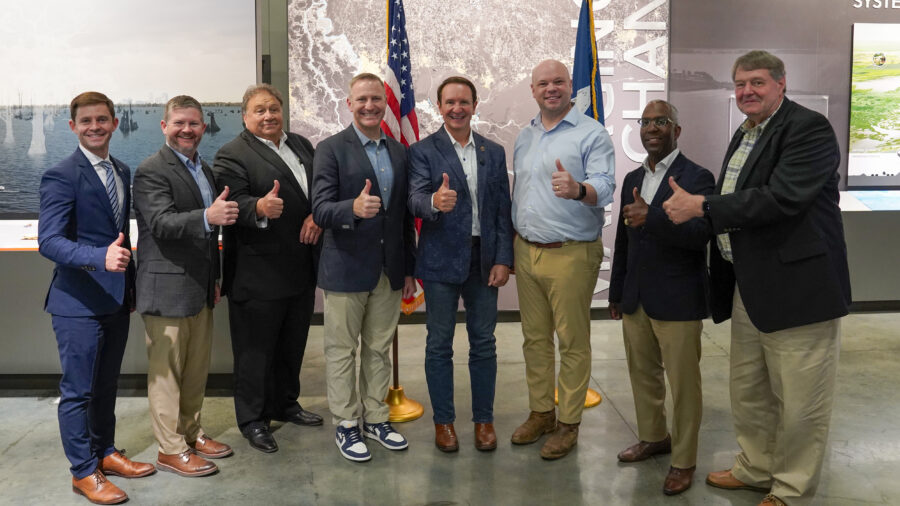
Leaders from the U.S. Army Corps of Engineers, the State of Louisiana, and partner agencies join together following the Summit at Sea Level to advance coastal resilience and infrastructure modernization.
CPRA / USACE Joint memo
BATON ROUGE, La. — In a display of intergovernmental unity, the Louisiana Coastal Protection and Restoration Authority (CPRA), the Louisiana Department of Transportation and Development (DOTD), and the U.S. Army Corps of Engineers (USACE) have agreed to a joint commitment to overhaul bureaucratic processes and accelerate coastal resilience efforts.
The agreement follows the “Summit at Sea Level,” hosted by CPRA and DOTD on Friday, June 26, 2026, in Baton Rouge. The event marked a rare convergence of top national, state, and local figures, bringing them together with federal partners, major industry associations, local governments, levee boards, ports, and private sector leaders to improve project delivery and maximize impacts, aiming for Louisiana to be the example for the rest of the country.
Key leaders of this effort included Assistant Secretary of the Army for Civil Works Adam Telle, Maj. Gen. Jason Kelly, USACE deputy commanding general for Civil and Emergency Operations, as well as executive leadership from CPRA and DOTD, and Gov. Jeff Landry and members of his administration.
Following the Summit, Secretary Telle praised the transparency of the discussions. “The Summit at Sea Level was such a momentous occasion for the U.S. Army’s Civil Works mission and the State of Louisiana…” Telle said. “The event was an open, honest, and exciting forum for all the stakeholders in the region to sit down and hash out our strategy going forward. The action items we are moving out on speak for themselves and how we are ‘Building Infrastructure, Not Paperwork’.”
Louisiana Gov. Jeff Landry sat down with Secretary Telle to close the event, stating, “If you all can get it right here in Louisiana, you can literally get it right anywhere else in the country.”
The catalyst for the Summit was to drive real action under the broad reforms of Assistant Secretary Adam Telle’s “Building Infrastructure, Not Paperwork” initiative. Attendees from across the public and private sectors together identified 19 priority actions designed to tear down administrative red tape, align complex permitting requirements, and significantly shorten project delivery timelines.
Joint Consensus and Strategic Takeaways
As a roadmap for future progress, CPRA, DOTD, and USACE will immediately begin working toward the following 19 identified action items:
- Ensure the implementation of the definition of physically separable elements maximizes the opportunities related to Section 1043(b) applications, allowing non-federal sponsors more opportunities to implement civil works projects.
- Work to implement real estate policies in line with Louisiana’s unique civil code to create long-term efficiencies in real estate agreements and land rights.
- Clarify best practices for project teams to determine the best sources for borrow and the best method of acquisition, eliminating the need for borrow pit waivers.
- Work towards “Nonstructural for Louisiana,” allowing the State of Louisiana to implement the residential nonstructural component of congressionally authorized projects. This currently includes over 10,000 structures in Calcasieu, Cameron, Vermilion, St. Mary, Iberia, St. Martin, and St. Tammany Parishes.
- Investigate creating a designated national area of significance for wetland mitigation within Louisiana to optimize ecological returns.
- Identify regional projects that utilize sediment from the Mississippi River and Tributaries (MR&T) to construct resilient wetlands in Louisiana, designating them as eligible for mitigation credit to offset upstream impacts within the MR&T system.
- Reassess long-term mitigation strategies to ensure future environmental offsets are directly tied to protecting the specific infrastructure projects causing the impacts.
- Establish clear lines of communication between CPRA and USACE on the timing of dredging activity for navigation to allow CPRA to coordinate and maximize the beneficial use of dredged material.
- Collaborate with Environmental Compliance Officers (ECOs) and water subcommittees to establish a pilot program for multipurpose banking frameworks, modeling the initiative after successful frameworks in Norfolk and Sacramento.
- Implement more consistent processes for the Interagency Review Team (IRT) to provide timely, predictable, and standardized evaluations regarding the creation, management, and ecological success of mitigation banks.
- Incorporate Louisiana’s coastal use permit application requirements directly into existing USACE digital permitting platforms to eliminate duplicate filings.
- Establish a formal Memorandum of Understanding (MOU) with the State of Louisiana in coordination with the Federal Permitting Improvement Steering Council (FPISC).
- Expand the use of Section 214 agreements to other eligible entities beyond state agencies on a case-by-case basis to accelerate third-party permitting in the public interest.
- Provide real-time status tracking via a public-facing permitting dashboard, incorporating clearly communicated, enforceable deadlines for regulatory reviewers. Collaborate with state and federal regulatory agencies to provide guidance and training for permittees in an effort to improve permit applications and expedite review.
- Utilize advanced automated technology to instantly screen incoming applications for completeness, flagging missing data back to applicants before embarking on lengthy manual reviews.
- Enter Memorandum of Agreement (MOA) or MOU to enable fiscal completion of the Comite River Diversion project while reducing Louisiana’s cost burden on other projects.
- Accelerate final construction contract awards for the Grand Isle beach nourishment and hurricane protection initiatives.
- Prioritize and finalize outstanding regulatory evaluations for key industrial infrastructure permits, including the Donaldsonville fertilizer plant expansion.
- Expedite the critical permitting and environmental review phases for the Louisiana International Terminal to support regional economic and maritime growth.
Leadership from both the State of Louisiana and USACE expressed enthusiasm for tackling this list of actions within the current legal framework. With this alignment, both entities are ready to make meaningful changes that benefit Louisiana and can serve as a framework for the rest of the country.
###
MEDIA CONTACTS:
James Lalino, Office of the Assistant Secretary of the Army for Civil Works, james.a.lalino.civ@army.mil
Eugene Pawlik, USACE Headquarters, eugene.a.pawlik@usace.army.mil
Ricky Boyett, USACE New Orleans District, ricky.d.boyett@usace.army.mil
Nakeir Nobles, USACE Mississippi Valley Division, nakeir.l.nobles@usace.army.mil
Ryan Shaw, CPRA, ryan.shaw@la.gov
Legal Disclaimer:
EIN Presswire provides this news content "as is" without warranty of any kind. We do not accept any responsibility or liability for the accuracy, content, images, videos, licenses, completeness, legality, or reliability of the information contained in this article. If you have any complaints or copyright issues related to this article, kindly contact the author above.
