

Reusing a Child’s Toy Avoids 90 Percent of Its Carbon Footprint, New Toycycle Analysis Finds
Reuse is the most significant sustainability lever for toys
Embodied carbon new manufacturing vs. reuse
Six-year operational dataset shows reuse — not recycling — is the most powerful sustainability lever in children’s toys.
Recycling for toys is mostly a story we tell ourselves. If you’re a parent wanting to reduce carbon impact, the lever is reuse. Eight lbs of CO₂ per toy, multiplied by household, across the country.”
HAYWARD, CA, UNITED STATES, June 17, 2026 /EINPresswire.com/ -- Toycycle (https://toycycle.co), the Bay Area curated online resale marketplace for children’s toys and baby gear, today released a lifecycle carbon analysis of its 30,000-item secondhand toy inventory. The report finds that reusing a toy avoids approximately 90 percent of its embodied carbon emissions, and that the company’s operations have displaced an estimated 119 tons of CO₂ since 2019.— Rhonda Collins, CEO at Toycycle
The report arrives at the seasonal peak of household toy cleanouts. Its argument debunks the dominant parent narrative: in fact, recycling, the default sustainability recommendation for everything from soda bottles to cereal boxes, is functionally unavailable for the mixed-material toys most American kids own.
The U.S. plastic recycling rate is 8.7 percent, and toys — combining rigid plastic, soft plastic, embedded electronics, fabric, and adhesives — are particularly hard for municipal programs to process. The lever, the report argues, is reuse.
“Recycling for toys is mostly a story we tell ourselves. The mixed plastics, the embedded electronics, the fabric — they don’t go anywhere,” said Rhonda Collins, Co-Founder and CEO of Toycycle. “If you’re a parent who wants to reduce carbon impact, the lever is reuse. Eight pounds of CO₂ per toy, multiplied across a household, multiplied across a country.”
The report identifies three findings:
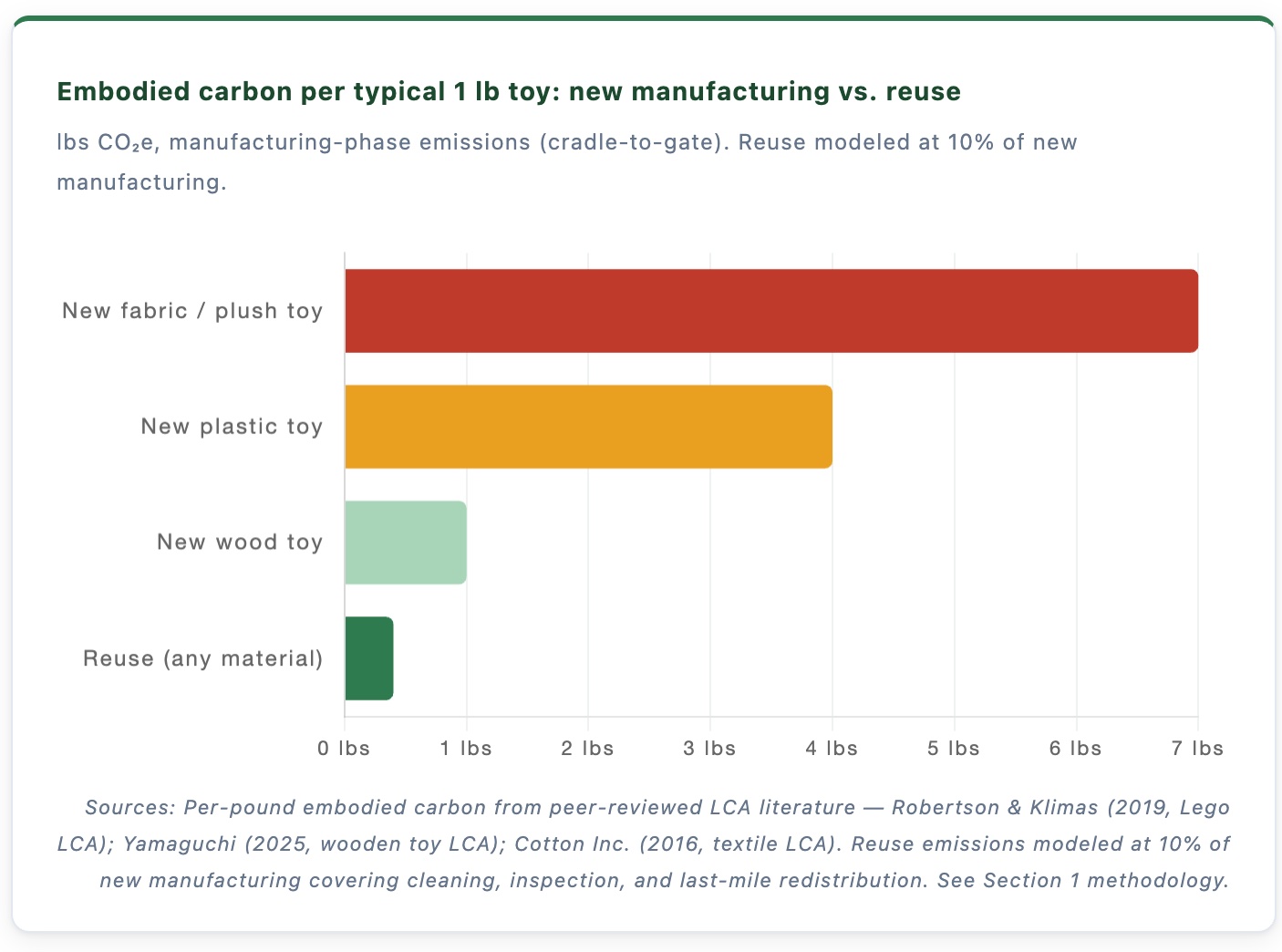
– Reuse avoids ~90 percent of a toy’s embodied carbon. Across plastic, wood, and textile categories, the bulk of a toy’s lifecycle emissions is locked in at manufacturing — not transport, not disposal. The single biggest sustainability decision is whether a toy is made at all, or kept in circulation.
– Recycling is functionally unavailable for most toys. The U.S. plastic recycling rate is 8.7 percent (EPA, 2018). Toys are particularly hard to process due to their mixed-material construction, leaving reuse as the only operational lever for the vast majority of household toy turnover.
– Peer-to-peer resale closes the carbon gap but opens a safety gap. Facebook Marketplace, eBay, and OfferUp avoid manufacturing emissions but skip CPSC recall cross-checks, hand inspection, and sanitization. Curated resale operators close both.
The report also introduces a five-step framework for parents that prioritizes reuse.
PlanToys, the sustainable wooden toy manufacturer cited in the report as a model of low-carbon manufacturing, has been a Toycycle Resale-as-a-Service brand partner.
“What truly sets Toycycle apart is their turnkey solution for giving products a second life. They have an exceptional ability to find these items a new, loving home, ensuring they stay in circulation,” said Rudy Valenta, former Vice President of Americas at PlanToys.
“The 119-ton figure is a measurement, not a marketing claim,” Collins added. “It’s a multiplication: 7.9 pounds of CO₂ avoided per item, times 30,000 verified listings, across six years of operations. We published the methodology because it’s straightforward enough that any parent can sanity-check it.”
METHODOLOGY NOTE
The analysis combines three peer-reviewed lifecycle assessments — Robertson & Klimas (2019) on Lego, Yamaguchi (2025) on wooden toys, and Cotton Inc. (2016) on textiles — with Toycycle’s verified resale volume. Per-pound embodied carbon factors used: ~4 lbs CO₂e/lb for plastic, ~1 lb CO₂e/lb for sustainably sourced wood, and 5–7 lbs CO₂e/lb for fabric and plush. Reuse-phase emissions are modeled at 10 percent of new manufacturing, covering cleaning, inspection, and last-mile redistribution. End-of-life emissions were excluded, making the avoided-emissions figure conservative. Full methodology and sources: https://toycycle.co/pages/used-toys-carbon-math
About Toycycle
Toycycle (https://toycycle.co) is a curated online resale marketplace for children’s toys and baby gear, founded in October 2019 in Hayward, California. The company ships nationwide, offers free curbside pickup in six San Francisco East Bay cities, and operates a Resale-as-a-Service platform for brand partners including PlanToys, Loog Guitars, Way2Play, Janod, Ekobo, Haba, and PJM Distributions. Toycycle was named in the Ellen MacArthur Foundation’s 2021 circular economy report on resale platforms.
Rhonda Collins
Toycycle PBC
email us here
Visit us on social media:
LinkedIn
Instagram
Facebook
Legal Disclaimer:
EIN Presswire provides this news content "as is" without warranty of any kind. We do not accept any responsibility or liability for the accuracy, content, images, videos, licenses, completeness, legality, or reliability of the information contained in this article. If you have any complaints or copyright issues related to this article, kindly contact the author above.
